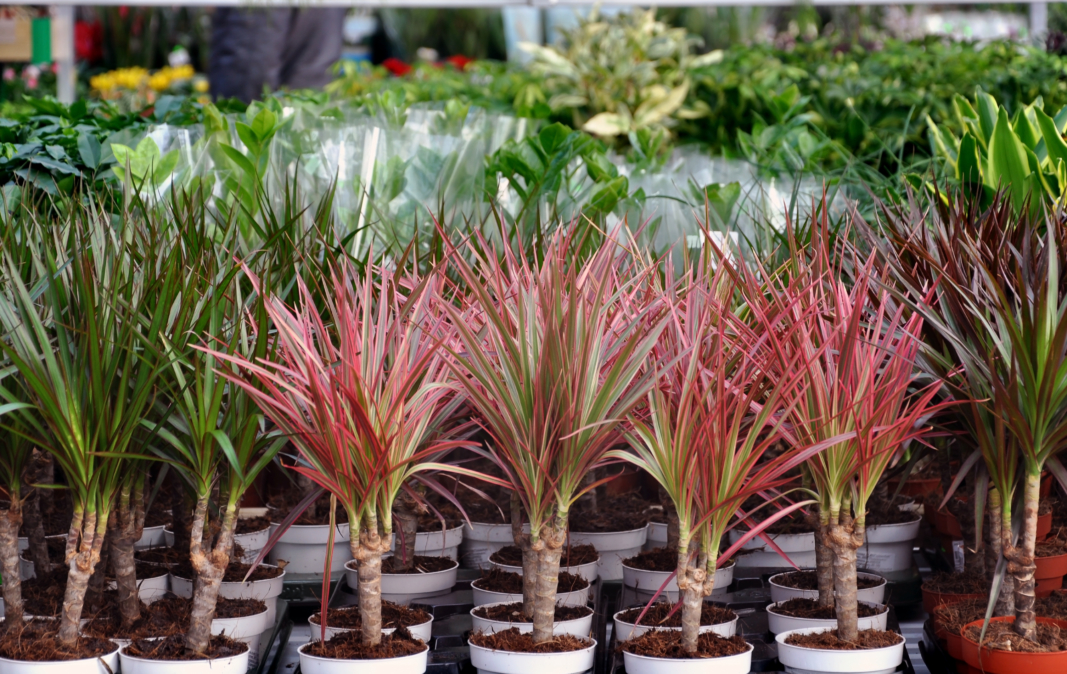
Dracaenas are popular in both homes and offices due to their wide variety of cultivars, low maintenance requirements and dependability. This is a great, versatile plant for a first time gardener or for someone looking for a plant that can endure through tough conditions. Small varieties grow perfectly on desks and tabletops, or you can grow a larger variety as a tall plant in a corner. If you are interested in any one of the many dracaena varieties, you can use this guide to ensure your plant receives the best care and grows for many years to come.
Dracaena plants do not need a lot of water. You can allow your plant to dry out almost completely between watering. If you stick your finger deep into the soil and it feels dry, it’s time to water the plant. Neglecting it too much will cause the leaves to brown at the tips, but it can withstand drought better than many other houseplants. During the spring and summer you will need to water it more often as it is actively growing. In the winter, you can reduce watering and may find your plant needs water only once every few weeks.
Rainwater or distilled water is best for your dracaena, but it’s not necessary. Excess salts, chlorine and fluoride that can be found in tapwater, may cause brown spots to develop on your plant’s leaves. You can also let your tap water sit out for 24 hours so that the minerals can evaporate.
Bright, indirect sunlight is best for dracaenas. They will perform well when placed a few feet from a sunny window or directly in a window behind a sheer curtain. Dracaena will tolerate much lower light conditions, though they will not grow as quickly. Place them in areas where the temperature does not dip below 50 degrees, as they may droop and brown in cold conditions.
A standard potting mix, such as Merrifield Potting Mix, suits dracaena’s needs. Plant your dracaena in a pot with a drainage hole, and if you want to do so, you can fertilize your plant once per month with an all purpose fertilizer like Schultz’s All Purpose (no need to fertilize in winter). It is not necessary to fertilize your dracaena! Most will do just fine in regular potting soil without extra amendments.
If you notice your dracaena’s leaf tips browning after being in the same pot for several years, this may be a reaction to salt buildup in the soil. You can either flush your plant’s pot with water until it runs clear from the bottom of the vessel, or go ahead and repot your plant in new soil. It’s generally best to go ahead and repot every couple of years to avoid salt buildup and overcrowding of your dracaena’s roots. If you see the roots are starting to protrude through the drainage holes, it’s time to repot.
Dracaena can grow very tall (up to eight feet), so you may find over time that they become too tall for their location. If you want to avoid moving your plant, you can use clean hand pruners to cut back the stems of your plant to your desired height. They will grow back over time!
Dracaenas are a fun and easy plant to propagate, if you want to try sharing your plant with friends and family! Start by sterilizing sharp pruners or a knife, then cut an eight-inch long stem from your plant with at least two leaves attached. Dip the cutting it in a rooting hormone (if desired) and either place it in a glass filled with water or directly into potting mix. If you choose to grow your cutting in water, it is best to change the water every other day.
If you are planting the cutting directly into potting mix, you will want to water it daily for the first month and then a couple times a week after that. Place your cutting in bright, indirect light. It will take six to eight weeks for your soil-bound cutting to develop roots, and two to eight weeks for a cutting in water to root. After about 8 weeks you can transfer your cutting in water to soil.
Dracaenas are susceptible to common houseplant pests, such as spider mites, thrips and mealybugs. If you check the underside of your plant’s leaves and along its trunk and base and see these, you can remove them by spraying the plants with a hose or wiping them with a cotton swab dipped in rubbing alcohol. You can also kill them by applying insecticidal soap and neem oil.
If you are not sure what issue is impacting your plant, we recommend bringing a small sample in a plastic bag to the plant clinic at our store for identification. You can also bring us a clear photo of the plant, showing the issue in detail! Our team will be happy to help you diagnose the issue and determine the most effective treatments.