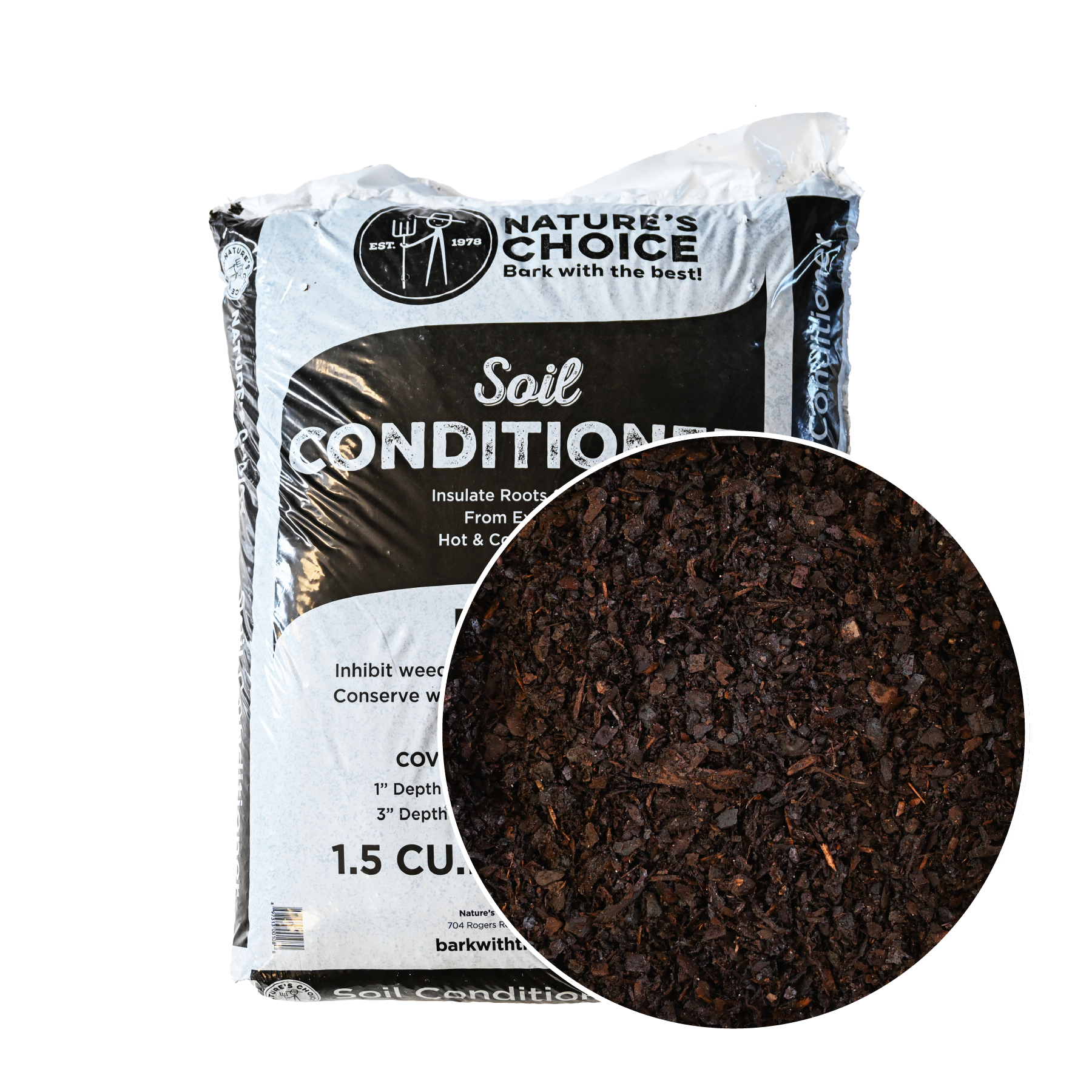
Premium Pine Soil Conditioner
$11.99
Nature’s Choice Soil Conditioner helps insulate plant roots and bulbs, protecting them from extreme weather, and can also be used as a top dressing or mulch in annual and perennial beds. This product accomplishes many gardening goals such as inhibiting weeds, conserving soil nutrients, encouraging earthworms, preventing erosion and developing your plants’ roots. It is made from ½” and smaller pieces of dark brown, aged pine bark fines. We recommend tilling it into your native soil to loosen clay particles and increase moisture retention in particularly sandy soils.
We stock Nature’s Choice Soil Conditioner in 1.5 cu. ft. bags. One bag of Nature’s Choice Soil Conditioner will cover approximately 16 sq. ft. at 1” deep.
We offer local delivery services for bagged and bulk products. In addition to delivery, we can also provide installation services. If you’re interested in having our team install your soil conditioner, please book a landscape appointment and select Garden Cleanup, Mulch and Sod as the appointment type.
When installing Nature’s Choice Soil Conditioner as a soil conditioner:
- Measure the length and width of your garden area to determine your square footage and put it into our convenient product calculator to determine how much soil conditioner you will need in your area.
- Remove any existing debris from your desired planting area, such as leaves, branches, roots and twigs. If your soil is particularly dry, compacted or dense, water the area 1 to 2 days in advance to make the soil easier to work with. Then, use a garden fork or rake to till the soil where you’ll be adding the soil conditioner. Be careful to avoid compacting the soil too much as you are tilling.
- Start spreading the soil conditioner around your desired area. We recommend applying a 2 to 3” layer of Nature’s Choice Soil Conditioner and working it into the top 4 to 6” of soil using a rake. This will help get the nutrients down into the root system. After you work and mix the conditioner into the soil, give it a thorough watering.
- We recommend applying Nature’s Choice Soil Conditioner annually in early spring before new foliage emerges. You can also apply it in the middle of the growing season to refresh your planting beds.
- If you’re planting in a new area of your yard, consider conducting a soil test. Soil tests are available through labs, universities and do it yourself test kits that we sell here at Merrifield Garden Center.
To give your established garden beds a boost of nutrients, topdress/mulch with Nature’s Choice Soil Conditioner:
- Apply a 1 to 2” layer of Nature’s Choice Soil Conditioner directly onto the surface of the bed.
- You can leave it on the surface as a "mulch-like" layer or lightly rake it into the very top layer of soil.
- This is best done in the fall to allow nutrients to break down over winter, or in the early spring before planting.
How do I know which soil conditioner to use?
Compost and other soil conditioners like Nature’s Choice Soil Conditioner, Coast of Maine’s Planting Soil for Roses & Flowers, McGills Premium Compost, Leafgro, Bumper Crop, and Soil Mate are all interchangeable and can be used anywhere in the landscape. With that said, they each have their own ideal application.
Nature’s Choice Soil Conditioner is useful when added to the soil of younger plants that are still developing their root system and can also be helpful as a mulch, top dressing areas of your garden to inhibit weeds and conserve nutrients and water. Coast of Maine’s Planting Soil for Roses & Flowers is ideal for growing flowering plants like roses in the ground or in containers. McGills works best when added to lawns. Leafgro and Soil Mate is the most economical choice and can be used in all locations. Bumper Crop works well in vegetable gardens. Soil Mate is similar to Leafgro and it is the only soil conditioner we offer in bulk.
How do I know how much soil conditioner to use?
We recommend measuring the length and width of the area you wish to condition to determine the square footage. Then, plug these numbers into our convenient product calculator to figure out how much soil conditioner you will need.
Shop Related Products
-
Merrifield Flowering Plant Food 10-18-12
Price range: $12.99 through $36.99 Select options This product has multiple variants. The options may be chosen on the product page -
Landscape Fabric
Price range: $1.99 through $899.99 Select options This product has multiple variants. The options may be chosen on the product page -
Merrifield Select Lawn Food 14-18-14
Price range: $12.99 through $39.99 Select options This product has multiple variants. The options may be chosen on the product page -
Straw (Bale)
$16.99 Select options This product has multiple variants. The options may be chosen on the product page