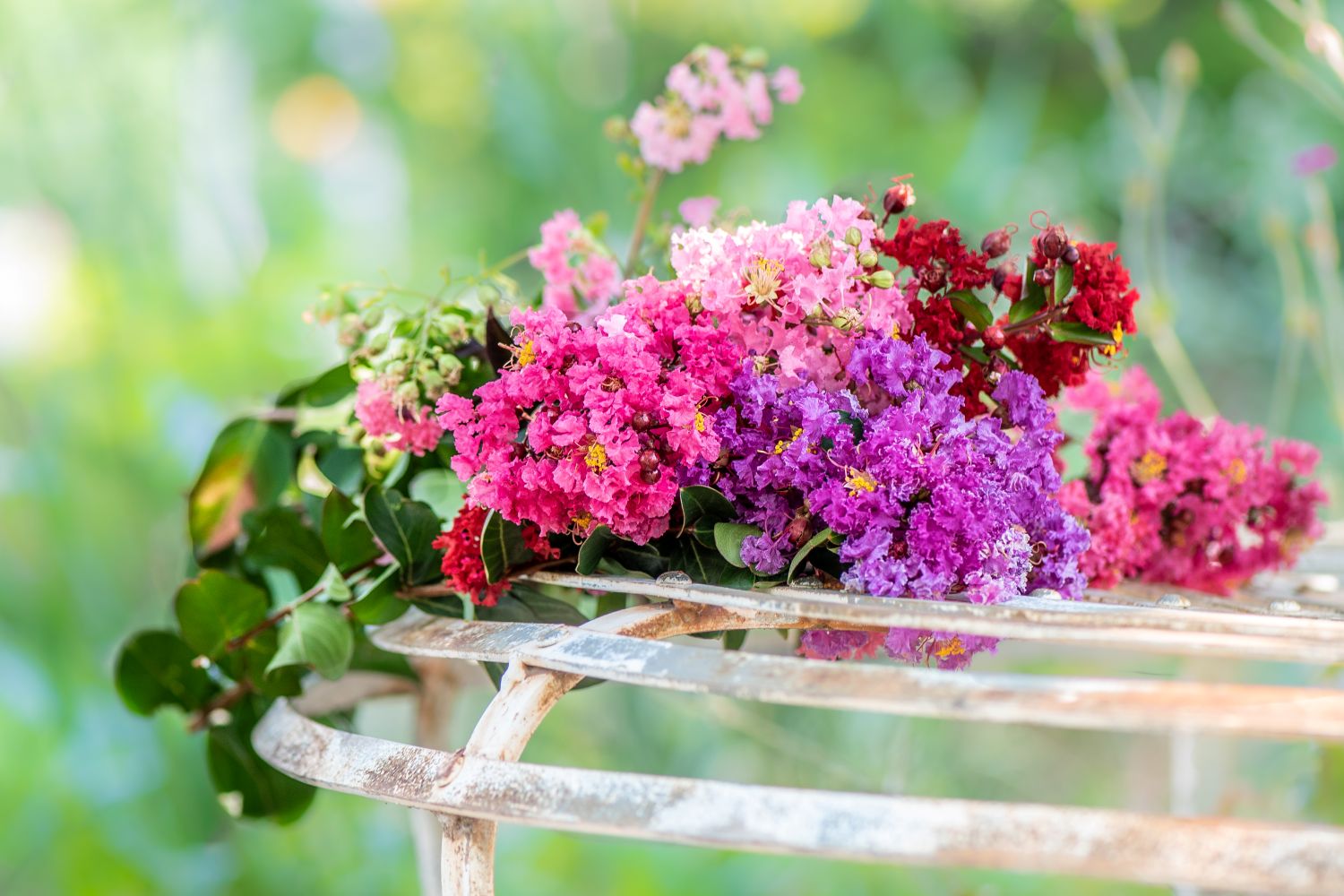
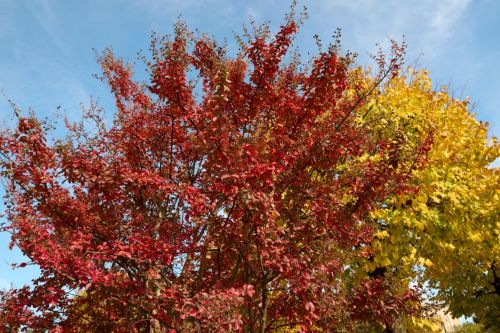
Crape myrtles are the stars of summer here in Virginia. These trees (and in some cases, shrubs) have something special for each season. From summer through fall they bloom in shades of white, pink, lavender, purple or red. As the blooms fade, their leaves will take on a variety of fall shades in orange and red. Even in winter, the peeling bark remains a beautiful feature of the garden
The U.S. National Arboretum has been cultivating hybrid crape myrtles since the 1960’s, which are popular in gardens to this day. The Native American Series, including famous varieties such as Natchez, Tuscarora, Muskogee, Acoma and Tonto, all come from the arboretum’s program. These cultivars were developed to resist disease, tolerate cold winters and produce a proliferation of blooms in summertime.
Shrub forms of crape myrtle will grow to about 6 feet tall, while the tree forms vary by cultivar but can reach up to 30 feet. There is a crape myrtle for every garden! This post contains both care information for crape myrtles in general, as well as some of our favorite cultivars in a variety of sizes. If you don’t see what you are looking for, we welcome you to consult our plant specialists at our stores for assistance!
Before purchasing a crape myrtle, you will want to determine whether your property can support shrub sizes or tree sizes. It’s important to choose a plant that will fit your space as it grows. If you’re wanting to add one to a patio, choose a dwarf form that will fit well in a container. If you have the space for a specimen tree or even a shade tree, there are taller options that will look magnificent in the garden.
Crape myrtles require at least 6 hours of direct sunlight. The more sunlight they receive, the more they will bloom! Look for locations in your garden that will allow your crape myrtle to really shine. To check the lighting in your garden, you can pop outside a few times each day to observe the sunlight at different times of day. Sunlight does not have to be all together in one block, it’s fine for the tree to receive a few hours of sun in the morning, then a few more hours later in the afternoon.
We recommend planting your crape myrtle between late fall and early spring to give it a head start growing its roots before the heat of summer. It is possible to plant your tree/shrub in summer! Just keep in mind that its watering needs will be much higher, so you will be doing a lot more work to keep it healthy.
While we recommend checking the soil around the plant before watering (see our watering guide for new trees and shrubs here), if you plant in the fall or early spring, you will likely find your tree can go 2-3 days between watering for the first month. After that you may find it can go every three days for around a month, until finally you can water deeply once a week through it’s first year, increasing to twice per week during heatwaves and dry spells. Be sure to water at the base of the plant, around the roots, to avoid powdery mildew.
You can prune your crape myrtles in the late winter or early spring, while they are dormant, as you would other deciduous trees. If you want a full guide, you can view our 3 Step Pruning video for deciduous trees. To maintain the tree’s health and natural shape, remove suckers and dead branches as you see them, as well as any branches that are diseased, crossing or rubbing other branches (which can damage the plant). It will not damage the plant to prune it later in the year, but be aware that pruning in the late spring or summer will cause the plant to put out less flowers.
Crape myrtles prefer neutral to slightly acidic soil over alkaline soil. They do not tolerate standing water, so you will want to plant your tree in a well-draining area.
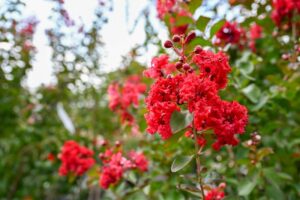
These blood-red flowers will last until frost. Its foliage turns to orange-red in the fall and it exhibits excellent resistance to powdery mildew.
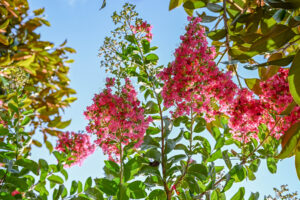
This tree-form crape myrtle will reach up to 25 feet tall at maturity. It is very resistant to powdery mildew and leaf spot, and can be used in the garden as a specimen tree.

Part of the Southern Living Plant Collection, this cultivar blooms purple to fuschia pink and will grow to 20 ft. tall over time.
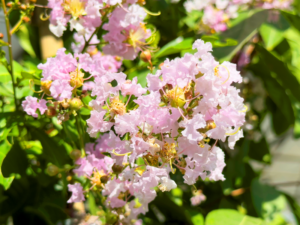
Developed in the U.S. National Arboretum, this crape myrtle is one of the tallest and most popular cultivars on the market, growing up to 25 feet tall at maturity. Use it in the garden as a focal point, privacy screen or specimen tree. Its flowers are a lavender hue.
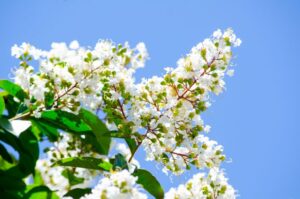
A majestic tree that will reach up to 30 ft. tall at maturity, this show-stopper features snow-white flowers and reddish-gold foliage in fall.

This popular, tree-form crape myrtle developed in the U.S. National Arboretum exhibits dark pink or coral-pink blossoms and will reach up to 20 feet tall at maturity. Its foliage will shift to shades of orange-red, maroon, and purple hues in the fall.
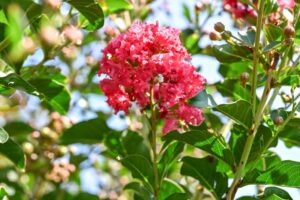
A notably fast grower, Tuscarora produces coral-pink flowers and foliage that turns a fiery-red in autumn.
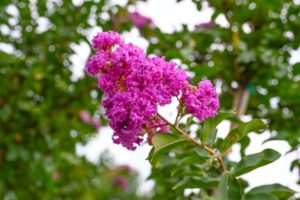
Known for its violet-purple flowers, this tree grows up to 15 ft. tall and boasts fiery red foliage in the fall.
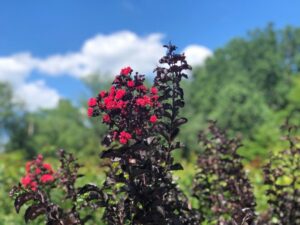
This series includes Radiant Red, Midnight Magic, Purely Purple and Twilight Magic. It boasts mysterious black foliage which keeps its hue until frost. It will reach up to 12 feet tall at maturity and is known to be exceptionally resistant to powdery mildew.
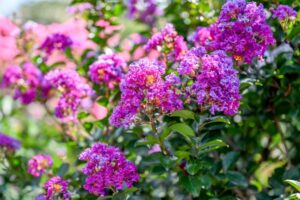
Known for its deep purple flower clusters, this cultivar of crape myrtle will mature to 10 feet in height and requires only minimal pruning in late winter to early spring.
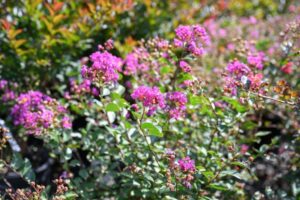
Also known as Bellini Grape, this crape myrtle is compact with grape-purple blooms. Its compact size makes it excellent in tight garden spaces, containers or in the front of borders.
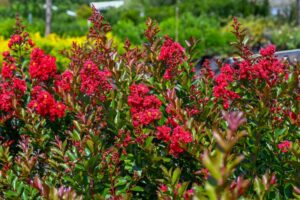
Developed by renowned horticulturalist Michael A. Dirr, this cultivar is very compact, only maturing to 5 ft. tall. Perfect as a low hedge or in patio containers. Enduring Red features vibrant red flower clusters. In fall, the leaves will shift to an orange-red or burgundy hue.
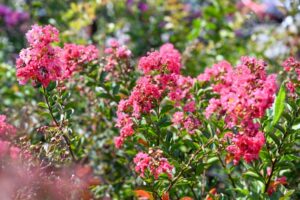
Also known as Bellini Strawberry, this crape myrtle is a sister plant to the Bellini Grape cultivar. Its flowers have a strawberry-red hue and it is also compact and wonderful for tight spaces in the garden and in containers.
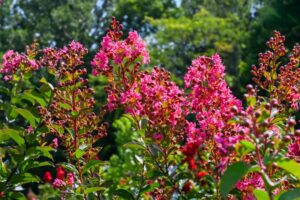
This award-winning semi-dwarf cultivar is compact in growth habit and boasts vibrant red to pink flower clusters.