Drainage Solutions
The most notable sign that you need a drainage solution in your landscape is water pooling whenever it rains. There are a few ways to fix drainage issues, such as using surface control systems, or installing a French drain, drain box or downspout piping. Sometimes elements of all systems are required to solve drainage challenges. Every home is unique and so is each solution.
If you encounter pooling water, take photos and videos of the damage or problem areas during or immediately after a heavy rainfall and book a Grading or Drainage Issues landscape appointment. Photos and videos of the direction the water is moving in your landscape are most helpful to investigating a potential solution. We can then work together to make sure you have the best drainage system possible for your unique needs. This page will educate you on the types of drainage solutions that are available.

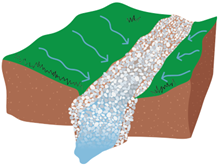 The most popular way to solve drainage problems is through a surface drainage system. Surface drainage focuses on redirecting water found on the surface of your landscape by reshaping the land through grading–sometimes done by hand or by machine. Surface drainage is only an effective solution when there is enough room to manipulate the land. It is dependent upon the shape, size and location of the property and the problem on the property.
Installing a surface drainage system only impacts the surface of the land and does not involve laying pipe or drainage boxes under the ground, requiring less regular maintenance. Since you’re working with the land to design this water management system, you may encounter some settling over time and need to revamp your surface drainage solution by top dressing using river jack or rock beds, removing debris or filling in low spots if they arise. Generally, we recommend evaluating your surface drainage system every 8 to 10 years to ensure it’s still achieving your goals.
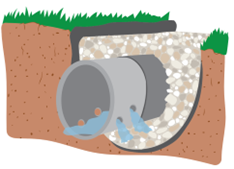 French drainage systems direct water through underground piping systems constructed with PVC or corrugated perforated pipes. The holes in the pipes distribute the water back into the ground as it moves. The drainage solution got its name after its founder, Henry Flagg French, an American farmer and judge, popularized the concept in 1859.
When you’re designing your French drain system, you can use a combination of perforated French drain pipes with solid PVC or corrugated pipes to direct the water where you want it to go. For example, if you run a French drain system under a permeable patio, you can connect it to solid pipes at the patio’s edge to bring the water further out into the yard. When choosing between PVC or corrugated pipes, keep in mind that corrugated pipes are easier to manipulate and more budget friendly while solid PVC is more long lasting.
To accomplish an effective French drain, the pipes must be placed on a slope so the water moves through them as it redistributes back into the land. If your area is not naturally sloped, do not worry, we can easily slope the land as we lay the system to ensure the water drains effectively.
When we install a French drain system, we dig a trench about 9 to 12” wide and at least 10” deep. Before placing the pipe, we will add a layer of 57 gravel to ensure adequate drainage from the perforated pipe into our naturally occurring clay-based soils in our area. We will also top the pipes with another layer of 57 gravel to ensure optimal filtration and water flow. The system is then topped off with river jack or another decorative gravel for aesthetic reasons. To keep your system working effectively, we recommend cleaning out the gravel to remove sediment and debris at least every 10 years.
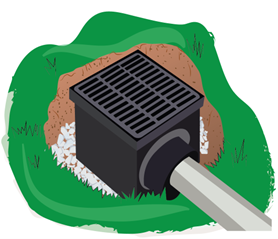 Drain boxes, also known as catch basins, are round or square plastic boxes that catch the water in a specific area of the landscape and run it out to other areas of your yard via PVC or corrugated piping. They are topped with a grate to prevent debris from entering the pipe system. You can place decorative rock at least ¾” or larger, such as river jack, seminole chips, pea gravel or Mexican beach pebbles on top of the grate to conceal the look in the landscape. This will also help to filter out some sediment as water rushes into the system.
Most often the drainage pipes will end by running into the surface of your land, a technique called daylighting as the pipes run until they see the light of day. If that’s not an option given the terrain, there is also the option to install a pop up emitter. When the pop up emitter fills with water after a heavy rain, it will release water from its spout, which will run off and dissipate into the landscape or eventually in the street or municipal drain. If you’re using a pop up emitter and placing it within your lawn, clear the surface of the emitter every 6 months as grass can grow over the top and prevent the water from escaping.
Every few years, we recommend reaching into the drain box with your hand to remove any leaves or sediment to keep the drain from clogging. You can also clean off the rocks with water to keep them looking attractive.
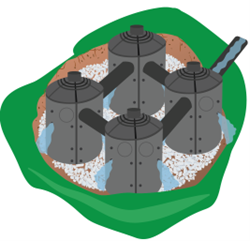 In addition to traditional drain boxes, we can also install channel drains, which are longer, narrower drain channels that are typically used around pools, driveways and sidewalks. If the area you’re experiencing drainage issues in is particularly flat and wet without the opportunity to add a slope, another solution is to use a dry well system. These are essentially drainage boxes, but larger, and they can be placed next to each other under a particularly flat area to capture the water and dissipate it back into the land, underground.
Downspout piping attaches to the end of the gutter downspout and runs underground to distribute the water away from the foundation of your home.
Downspout pipes are traditionally constructed from corrugated or PVC pipe and are placed underground at least 8” deep in the landscape. The water collected in the gutter runs down the downspout, into the connected pipe and is daylighted into the yard or distributed via a pop up emitter. Each year as you clean your gutters, check your downspout pipes and remove leaves and other debris to keep the pipes clean. If you’re using a pop up emitter and placing it within your lawn, clear the surface of the emitter every 6 months as grass can grow over the top and prevent the water from escaping.
Book an appointment with our drainage experts today
Schedule an Appointment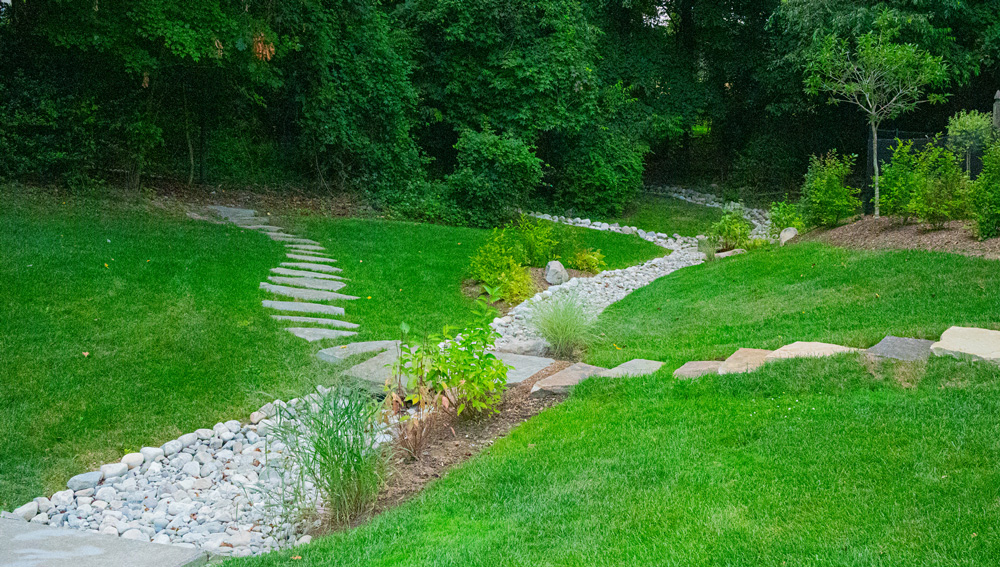
We would love the opportunity to meet with you about your drainage issues. If you’re interested in having a drainage expert come to your home for a consultation, take photos and videos of the issues during or immediately after a heavy rain. After a heavy rainstorm you can see the direction in which the water is moving and the severity of the pooling. Then, book a Grading or Drainage issue appointment to have one of our experts meet you at your home.
When you meet with our drainage expert, we will give you options to achieve the best results in your yard. Every yard is unique and needs different types of drainage based on your particular needs.
Often our drainage experts will recommend a combination of drainage solutions for your property depending on the goals you’d like to achieve. While water problems can often be corrected by implementing one drainage solution, sometimes techniques are combined to achieve aesthetic goals. For example, you can use a drainage box to collect the water in an area and then grade the surface to place a connecting patio or surface nearby. You can also use a drain box to collect the water and then distribute it with a French drain system into a river jack stream bed. Our team of grading experts will work hand in hand with you to understand your goals and design a drainage system to fit your needs and address your water challenges.